If you have been browsing the mechanical keyboard market lately, you have likely seen the explosion of “Hall Effect” (HE) and “Rapid Trigger” keyboards flooding the scene from China. Brands like ATK, Womier, and DrunkDeer are promising specifications that rival the industry king, Wooting, but at half the price. The boldest claim? 8,000Hz (8K) Polling Rate.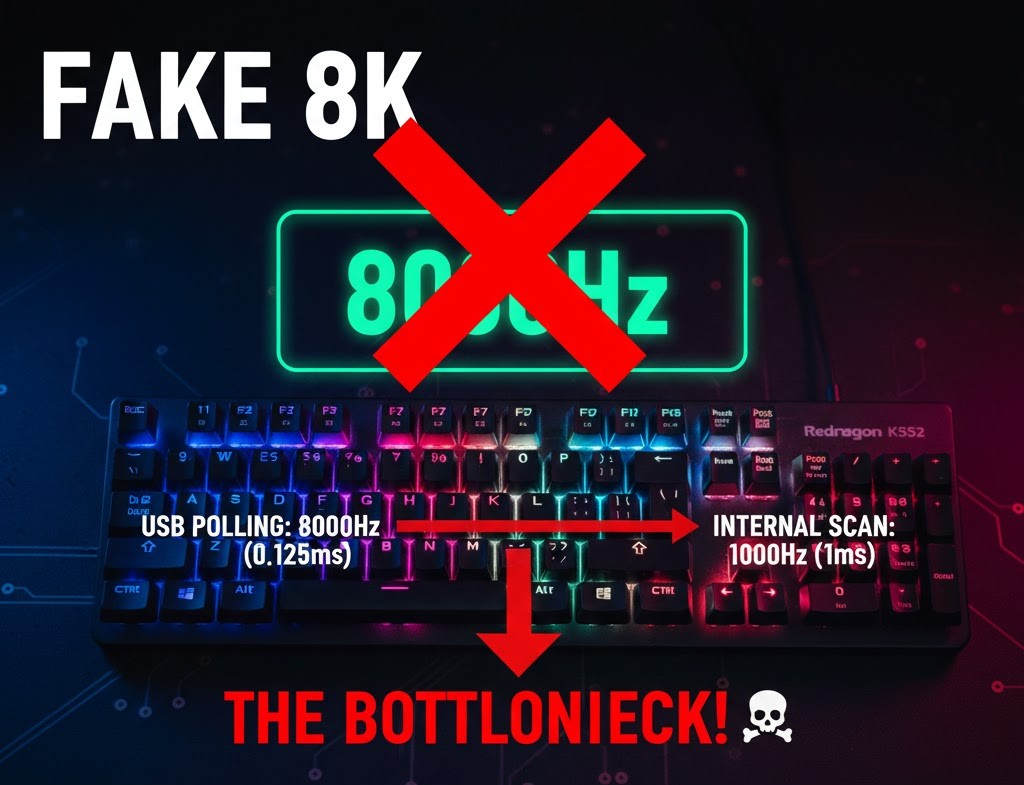
But in an industry rife with marketing buzzwords, skepticism is healthy. Can a $75 keyboard really deliver the same 0.125ms speed as a $175 flagship? We investigated the technical breakdown of Chinese custom keyboards to find out which ones are engineering marvels and which are just marketing fluff.
The Core Problem: Polling Rate vs. Scan Rate
To understand if a keyboard is “Real 8K,” you have to distinguish between two completely different metrics. Most budget manufacturers bank on you not knowing the difference.
1. Polling Rate (The USB Speed)
This is how often the keyboard sends data to your PC.
- 1,000Hz: Reports every 1ms.
- 8,000Hz: Reports every 0.125ms.1
- The Reality: Almost any modern microcontroller can handle 8K USB reporting. It is easy and cheap to implement.
2. Scan Rate (The Internal Speed)
This is how often the keyboard’s processor checks (scans) the actual keys to see if they have moved.
- The Bottleneck: If a keyboard reports to the PC 8,000 times a second (8K Polling), but only checks the keys 1,000 times a second (1K Scan), the 8K label is useless. The keyboard is simply sending the exact same “old” data to the PC eight times in a row.
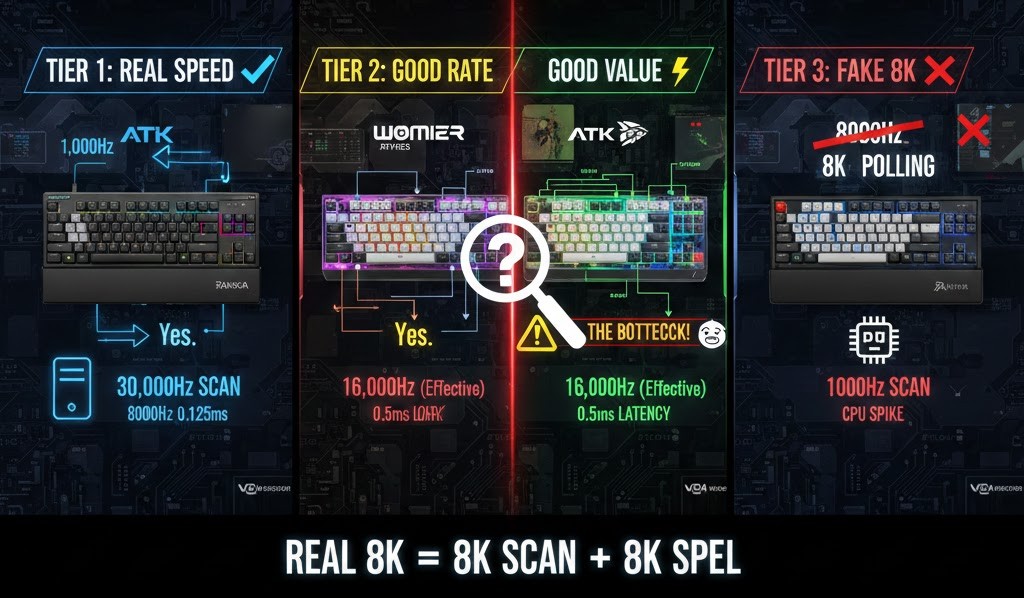
The Verdict: A “Real” 8K keyboard must have a Scan Rate of at least 8,000Hz.
The Investigation
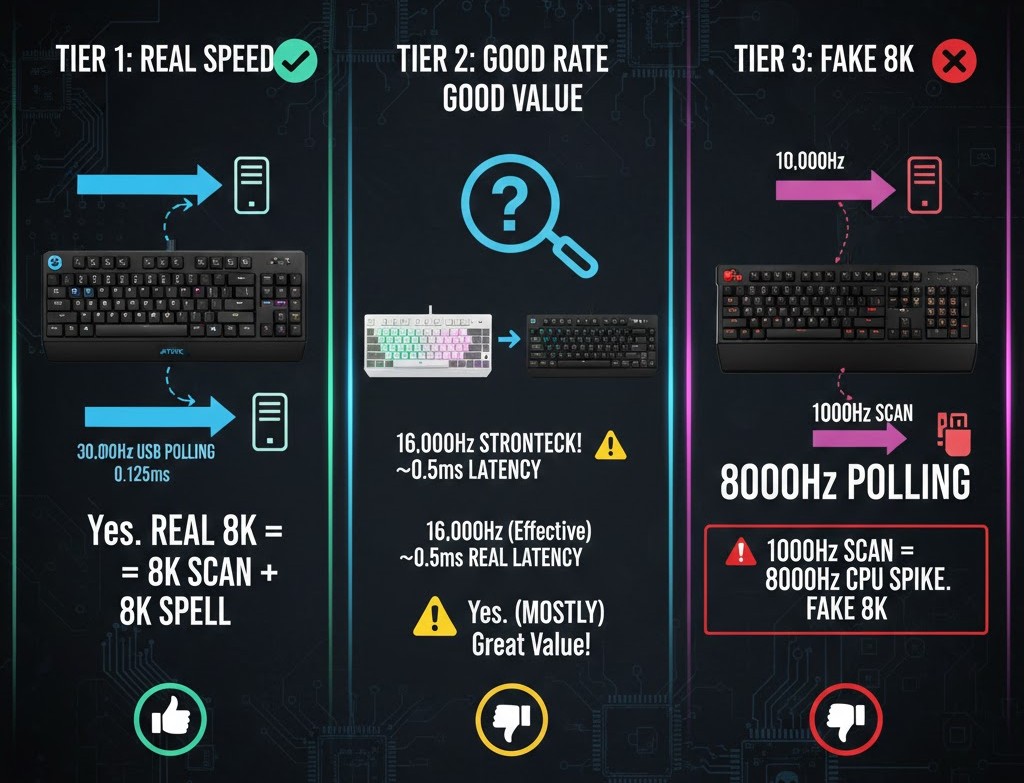
Based on latency analysis and technical teardowns, the Chinese market is currently split into three tiers.
Tier 1: The “Verified Real” Speed Demons
These brands are not just matching the hype; in some cases, they are pushing the technology further than Western competitors.
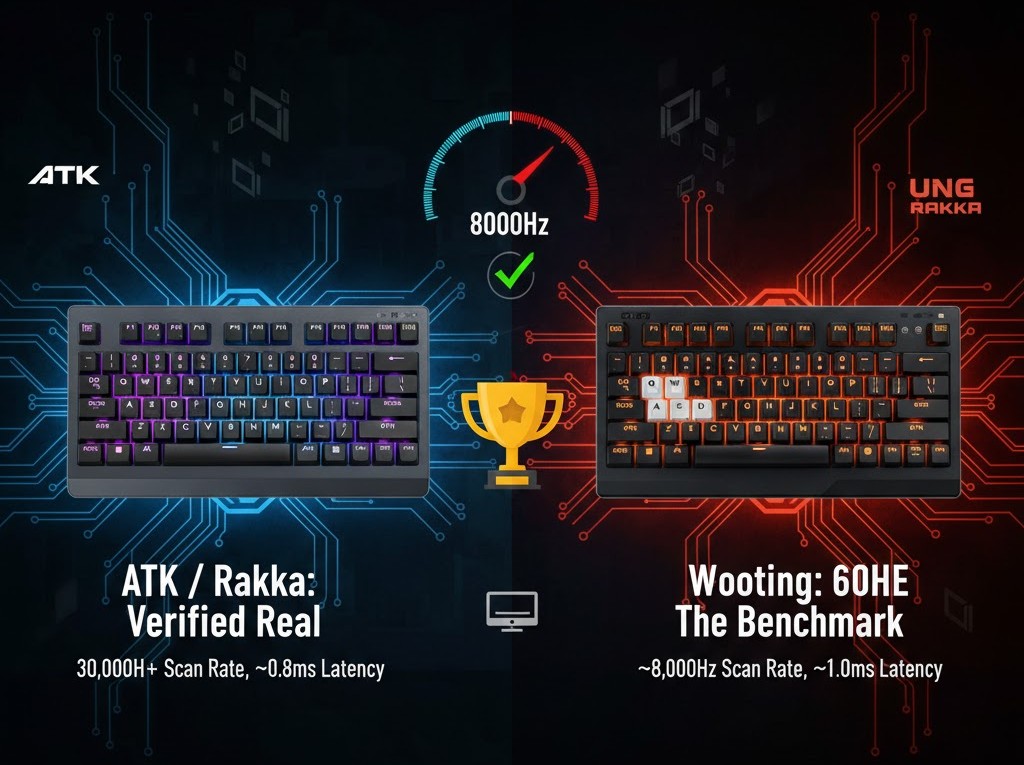
Rakka (e.g., Rakka 60 / Atlas)
Rakka is a niche favorite among enthusiasts for a reason. They don’t just meet the 8K standard; they often exceed it.
Is it Real? Yes.
The Numbers: Rakka boards often utilize a Scan Rate of 30,000Hz+.
Performance: This ensures that the 8K polling rate is fully saturated with fresh data. The end-to-end latency is consistently in the top 1% of all keyboards worldwide.
ATK / VGN (e.g., ATK 68, RS7)
ATK (an offshoot of VGN/VXE) is the most aggressive “Wooting Killer.”
Is it Real? Yes.
The Numbers: Independent testing confirms their “Smart Speed X” technology delivers sub-1ms latency. While their marketing materials are aggressive, the hardware backs it up.
Performance: In comparative latency tests, the ATK 68 often trades blows with the Wooting 60HE, usually sitting within a margin of error of 0.1ms to 0.3ms.
Tier 2: The “Effective” 8K (Great Value)
These keyboards are “real” in the sense that they offer high-performance gaming advantages, even if their scan rates aren’t quite as extreme as Tier 1.
Womier (e.g., SK75 TMR)
Womier recently shifted from standard RGB boards to performance TMR (Tunnel Magnetoresistance) sensors.
Is it Real? Mostly.
The Numbers: Marketing claims a 16K scan rate. While sustained real-world scanning may fluctuate, TMR sensors are naturally faster and more power-efficient than traditional Hall Effect sensors.
Performance: The board provides a massive upgrade over 1K mechanical keyboards. You are getting ~0.5ms to 0.8ms real-world latency, which is indistinguishable from “perfect” 8K for 99.9% of humans.
DrunkDeer (Pro & Master Series)
Is it Real? Yes, but with a catch.
The Caveat: The standard DrunkDeer A75 is a 1K polling board. You must buy the Pro or Master versions to get the upgraded MCU capable of 8K.
Performance: The Pro/Master series successfully delivers the rapid response required for high-tier Valorant or CS2 gameplay.
Tier 3: The “Fake” 8K (The Marketing Trap)
These are usually the budget boards (under $50-$60) found on AliExpress or Amazon under various alphabet-soup brand names.
The Brand Suspects: Redragon (select models), Irok, and generic white-label OEM boards.
The Lie: They list “8K Polling” on the box because the USB cable transmits at 8K.
The Reality: The scan rate is often locked at 1,000Hz (or sometimes even 500Hz).
The Result: You get 1ms of latency (at best), but your CPU usage spikes because it’s processing 8,000 empty reports per second.
The Data: “Yes” vs. “No” Latency Comparison
To put this into perspective for your readers, here is what the latency looks like when you press a key.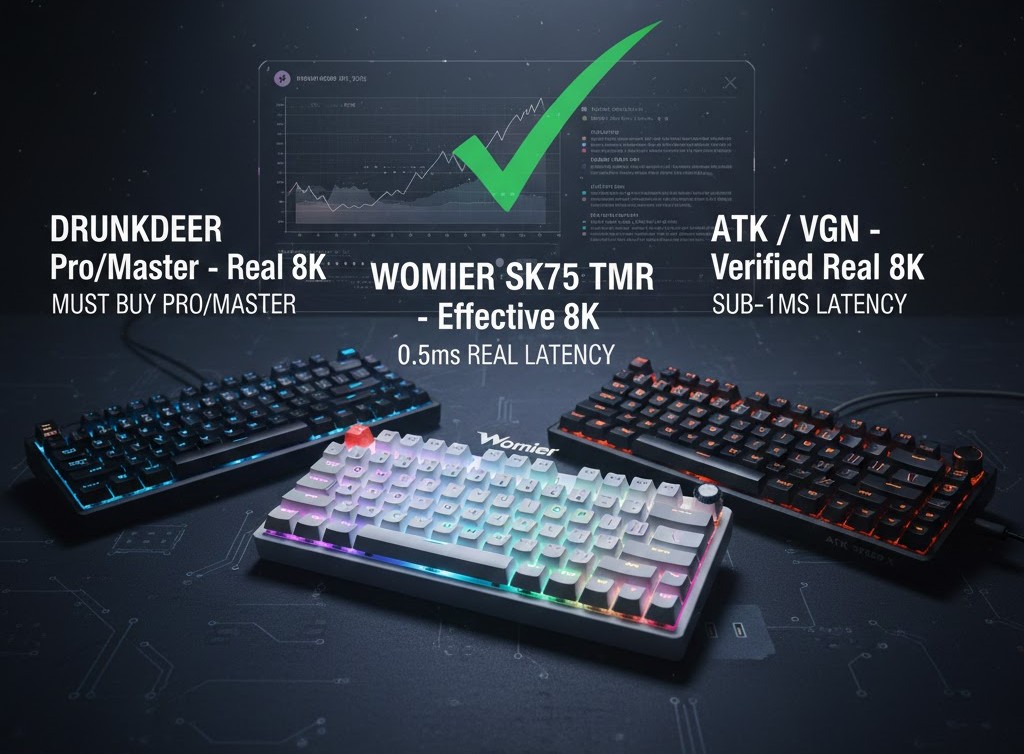
| Keyboard Type | Claimed Polling | Real Scan Rate | Theoretical Latency | Real World Latency (Approx) |
| Wooting 60HE (Benchmark) | 8,000Hz | ~8,000Hz+ | 0.125ms | ~0.7ms – 1.2ms |
| ATK / Rakka (Tier 1) | 8,000Hz | >8,000Hz | 0.125ms | ~0.8ms – 1.3ms |
| Womier TMR (Tier 2) | 8,000Hz | High (Variable) | 0.125ms | ~1.0ms – 1.5ms |
| “Fake” 8K Board (Tier 3) | 8,000Hz | 1,000Hz | 1.0ms | ~2.5ms – 4.0ms |
Note: Real-world latency includes switch travel time and processing. Anything under 2ms is considered “Esports Ready.”
Conclusion
Chinese manufacturers like ATK and Rakka have successfully reverse-engineered the high-performance meta. They are no longer just making “clones”; they are making legitimate high-performance peripherals that force big brands to lower their prices.
However, if you see a keyboard for $40 claiming 8K polling, it is almost certainly a marketing gimmick. For true 8K performance, expect to pay between $70 and $110—still a bargain compared to the $175+ price tag of western competitors, but high enough to ensure the internal processor can actually handle the speed.
If you want the performance of a Wooting but only have $100, buy an ATK RS7 or Womier SK75. You are getting 95-99% of the performance for 50% of the price.
About The Author